How to cook hilsa (ilish)
Hilsa, or ilish, is the fish Bengali families save for special days: rich, tender and full of flavour. This guide shows you how to thaw and cut frozen hilsa, then cook three classics – ilish bhaja, shorshe ilish and ilish paturi – with exact quantities and timings, plus tips for handling the fine bones. Whole fish and steaks are in our hilsa range, and the rest of the pantry is in Bengali groceries.
Why hilsa is special
Hilsa – ilish in Bengali, Elish Fisch on many German labels – is the fish Bengali families on both sides of the border talk about with real emotion. It is a rich, oily fish from the herring family with delicate, almost buttery flesh and a flavour that needs very little help: turmeric, salt, mustard and green chilli are usually enough. The catch is the bones. Hilsa has a lot of fine, forked bones, so it is eaten slowly, with rice and your fingers, and nobody is in a hurry.
In Germany you will almost always buy hilsa frozen. At Tukwila you'll find whole fish of different sizes, sold per kilo, as well as ready-cut hilsa pieces and hilsa roe (ilish dim). Larger fish – the "boro ilish" of around 1.1–1.4 kg – carry more fat and give thicker steaks, which many cooks prefer for shorshe ilish.
Thawing and cutting
Thaw slowly
Put the frozen fish in a dish in the fridge and give it 12–24 hours, depending on size. Slow thawing keeps the flesh firm and stops the steaks from falling apart in the pan. Avoid warm water, and never refreeze fish once it has thawed. Frozen orders are shipped Monday to Wednesday in an insulated box, so put the fish straight into the freezer when it arrives if you aren't cooking it that day.
Scale, clean and cut
- Scrape off the scales with the back of a knife, working from tail to head.
- Cut off the head and set it aside – it adds lots of flavour to dal or a dish of greens such as kochu shaak.
- Open the belly, remove the innards and keep any roe separately.
- Cut the fish crossways into steaks about 2–2.5 cm thick. The back pieces are called gada, the softer belly pieces peti.
- Rinse briefly under cold water. Bengali cooks wash hilsa as little as possible, as too much water carries the flavour away.
Pat the pieces dry with kitchen paper, rub them with 1 teaspoon turmeric and 1 teaspoon salt per kilo of fish and leave for 10 minutes.
Recipe 1: ilish bhaja (fried hilsa)
The simplest method and, for many, the most loved. For 4 people you need 800 g–1 kg hilsa steaks, turmeric, salt and 5–6 tablespoons of mustard oil. Check the label: in the EU some bottles are marked "for external use only", so for cooking choose an oil that is clearly sold as edible cooking oil.
- Heat the oil in a wide pan until it just begins to smoke, then turn the heat down to medium. This mellows the sharpness of the mustard oil.
- Slide in the marinated steaks in a single layer. Don't crowd the pan.
- Fry for 3–4 minutes per side, without moving them, until golden and lightly crisp at the edges. Turn only once.
- Lift out and drain on kitchen paper.
Don't throw away the oil. The fragrant ilish tel is poured over hot rice with a pinch of salt and a green chilli – one of the simplest pleasures of Bengali food. Fry the roe the same way for about 2 minutes per side.
Recipe 2: shorshe ilish (hilsa in mustard sauce)
This is the dish most people mean when they talk about hilsa. For 4 people:
- 6–8 hilsa steaks
- 3 tbsp mustard seeds (brown, or half brown and half yellow)
- 4–5 green chillies
- ½ tsp turmeric and salt
- 4 tbsp mustard oil, plus a little extra to finish
- ½ tsp kalonji (nigella seeds)
- about 150 ml water
- Soak the mustard seeds in warm water for 20–30 minutes. Grind them with 2 green chillies, a pinch of salt and 2–3 tablespoons of water into a smooth paste. Keep it brief – over-grinding turns mustard bitter.
- Heat the oil, add the kalonji and let it sizzle for a few seconds.
- Mix the mustard paste with the turmeric and water, pour it into the pan and bring to a gentle simmer.
- Lay in the steaks in one layer, top with slit green chillies, cover and cook on a low heat for 10–12 minutes. Shake the pan rather than stirring so the fish stays whole.
- Finish with a drizzle of raw mustard oil and leave to rest for 5 minutes.
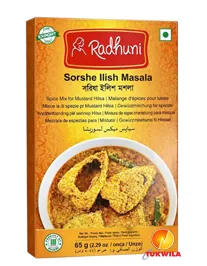
Short on time? Radhuni's ready-made sorshe ilish masala stands in for the homemade paste.
Recipe 3: ilish paturi
Paturi means "wrapped". Coat each steak with the same mustard paste plus 1 tablespoon grated coconut and 1 teaspoon mustard oil. Wrap it in banana leaf if you have some, otherwise in baking paper and then foil. Cook the parcels in a covered pan over a low heat for 15 minutes, turning once, or steam them for the same time. Open them at the table so everyone gets the aroma.
Eating hilsa without worrying about bones
- Choose back pieces (gada) for guests who are new to hilsa – the main bones are easier to find.
- Eat with your fingers and plenty of rice: you feel the fine bones long before you swallow them.
- Give children belly pieces and check them first.
What to serve with hilsa
Plain boiled rice is the classic partner. On rainy days, Bengalis pair ilish bhaja with khichuri made from moong dal and gobindobhog rice. For Pohela Boishakh, the Bengali New Year, the traditional plate is panta bhat with fried hilsa, raw onion and green chilli. A simple masoor dal tempered with panch phoron and a little aloo bhorta complete the meal.
Frequently asked questions
Do I need to thaw hilsa before cooking?
Yes, ideally slowly in the fridge for 12 to 24 hours, depending on size. Half-frozen fish is actually easier to cut into steaks, but for frying or the mustard sauce it should be fully thawed and patted dry.
Which mustard seeds do I need for shorshe ilish?
Brown mustard seeds are traditional, often mixed with yellow ones for a milder sauce. Soak the seeds for 20 to 30 minutes and grind them only briefly with green chilli and salt, otherwise the paste can taste bitter.
How do I deal with all the bones in hilsa?
You can't remove the fine bones completely. Back pieces have larger bones that are easy to find, while belly pieces are softer. Eat slowly with your fingers and plenty of rice, and you'll feel the bones in good time.
Can I order hilsa online?
Yes. We ship whole hilsa, steaks and roe frozen with GLS from Monday to Wednesday in an insulated box, with a cool-box fee of €9.99. In Dresden you can also buy it at our shop on Bautzner Straße 16.